How To Post a Score when Hole Started But Not Completed
Rule 3.3 – Rules of Handicapping
Rule 3.3 Rules of Handicapping outlines how to assign the correct score when a player starts the hole but does not hole out.
There are various circumstances that might result in a player starting a hole but not holing out. For example, when:
-
- The result of the hole has already been decided,
- A hole has been conceded in match play,
- A player’s partner has already posted a better score in a Four-Ball format and the player picks up, or
- A player has already reached their net double bogey limit on a specific hole.
When a player starts a hole but does not hole out for a valid reason, subject to other provisions set out within the Rules of Handicapping, the player must record their most likely score or net double bogey, whichever is lower, as appropriate for the situation and depending on the format of play.
The most likely score is:
-
- The number of strokes already taken to reach a postion on a hole, plus
- The number of strokes the player would most likely require to complete the hole from that position, plus
- Any penalty strokes incurred during play of the hole.
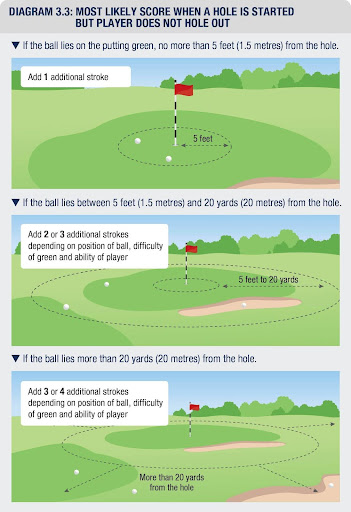
Most likely scores should be determined on any hole in accordance with the following guidelines:
| Position of the Ball | Strokes to be Added |
| If the ball lies on the putting green, and is no more than 5 ft (1.5 m) from the hole | Add 1 additional stroke |
| If the ball lies between 5 ft (1.5 m) and 20 yards (18 m) | Add 2 or 3* additional strokes, depending on the position of the ball, the difficulty of the green and the ability of the player |
| If the ball lies more than 20 yards (18 m) | Add 3 or 4* additional strokes depending on the position of the ball, the difficulty of the green and the ability of the player |
*Addition of strokes should always include the reasonable assessment of the number of strokes needed to complete the hole.
Notes:
- There is no limit to the number of most likely scores that can be recorded within a player’s adjusted gross score, provided that the failure to hole out is for a valid reason and not for the purpose of gaining an unfair scoring advantage.
- For players with an established Handicap Index, the most likely score on any hole cannot exceed net double bogey for handicap purposes.
- When a player is submitting scores for an initial Handicap Index, the most likely score on any hole cannot exceed par plus 5 strokes.
- In a Maximum Score format of stroke play, there may be situations where a player has not reached their net double bogey score before reaching the maximum score as determined by the Terms of the Competition. In such cases, the player should record either a most likely score or net double bogey, whichever is the lower score (see Rules of Golf, Rule 21.2).